Dental Excuse Note Canva Template: Professional Design, Simplified
In the fast-paced world of healthcare administration, the small details often leave the biggest impressions. A patient’s interaction with your practice doesn’t end when they leave the chair; it extends to the paperwork they take with them. Specifically, when a patient needs a Dental Excuse Note for work, school, or insurance purposes, the document they present needs to reflect the same level of professionalism as your clinical care. This is where the Dental Excuse Note Canva Template steps in, bridging the gap between medical necessity and brand identity.
Forget the days of generic, typewriter-font notes on plain white paper. Modern practice management requires a blend of efficiency and visual appeal. This template is designed not just as a functional form, but as a piece of brand identity collateral. It acknowledges that every touchpoint is an opportunity to reinforce trust. Whether you are a solo practitioner, an orthodontist, or part of a large dental group, the ability to provide a polished, official document instantly is a game-changer for your workflow.
The Visual Personality of the Template
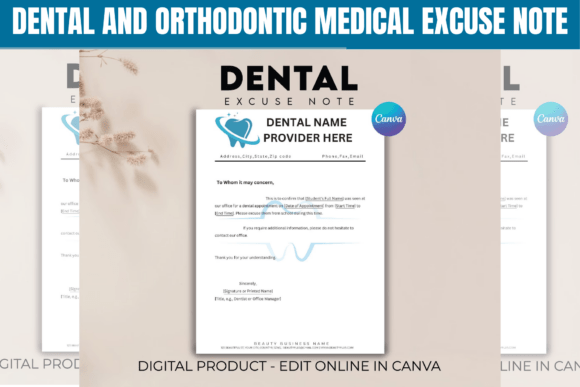
At its core, this is a premium font driven design asset that prioritizes clarity without sacrificing style. The visual characteristics of the template lean toward a "clinical-chic" aesthetic. You won’t find cluttered borders or distracting cartoons here. Instead, the layout relies on strong visual hierarchy. The typography is clean, utilizing a mix of sans serif font styles for body text to ensure maximum readability, often paired with a subtle script font or elegant serif for the practice name header.
The overall appeal is one of organized calm. There is ample white space, which is a critical element in editorial design and document creation. This negative space ensures that the vital information—patient name, date of service, and return date—is immediately accessible. The personality of the design is authoritative yet approachable. It signals to the recipient (whether it’s an HR manager or a school nurse) that this document comes from a legitimate, established practice that cares about its presentation. It transforms a mundane administrative task into a moment of brand consistency.
Strategic Applications and Brand Consistency
While the primary function is medical documentation, the utility of a well-designed template extends far beyond the front desk. In terms of brand strategy, consistency is king. When your excuse notes match the aesthetic of your business cards, appointment reminders, and website, you build a subconscious layer of trust with your patients.
This template works best when viewed as a versatile design asset. For the marketing-minded practice owner, it is an extension of your logo design and color palette. Imagine a patient handing over a note that features your exact brand colors, your logo crisply rendered, and typography that matches your intake forms. It tells a story of professionalism.
Furthermore, the digital nature of this product makes it ideal for modern workflows. It is not just a static file; it is a dynamic tool. You can use it for:
- Standard Patient Care: The obvious use for post-procedure recovery or orthodontic adjustments.
- Urgent Care Scenarios: Speed is essential when a patient is in pain. The template allows for rapid data entry and printing.
- Remote Administration: If you are managing a practice remotely or need to send a digital copy via email, the PDF output is crisp and professional.
- Insurance Documentation: Sometimes insurers require proof of visit; a well-formatted letter carries more weight than a scribbled note.
Customization: A Masterclass in Flexibility
The true power of the Dental Excuse Note Canva Template lies in its editability. Canva has democratized design, allowing business owners to act as their own graphic designers without needing to master complex software like Adobe InDesign or Illustrator. This template leverages that accessibility.
You are not locked into a rigid structure. The "full customization options" mean you can adjust every pixel. If your brand identity relies on a specific modern typography style—perhaps a geometric sans-serif—you can swap the fonts in seconds. If you prefer a warmer, more human touch, you might introduce a handwritten font for the "Thank you" footer, adding a layer of empathy to the clinical data.
Consider the "drag and drop" functionality for your logo. A logo placed poorly can look amateurish; placed correctly within a grid, it anchors the document. The template provides the grid structure, and you provide the content. This is particularly useful for packaging design principles applied to paperwork—treating the note as a "package" of information that needs to be delivered neatly. You can resize text blocks to accommodate different lengths of medical notes or specific instructions for the patient’s care, ensuring the layout never looks cramped.
Evaluating Fit and Typography Pairings
When you download this asset, you are essentially acquiring a pre-vetted font pairing system. Good design often relies on the contrast between typefaces. This template usually pairs a sturdy, professional serif or sans-serif for the main body with a display font for the headers.
However, evaluating fit is crucial. Ask yourself: Does this visual tone match my patient demographic? If you run a pediatric dentistry clinic, you might want to tweak the colors to be more vibrant. If you are a high-end cosmetic dentist, you might stick to the minimalist black-and-white palette and focus on the elegance of the serif font used for the header.
Readability is the non-negotiable metric here. While script fonts look beautiful, they should rarely be used for dense paragraphs of text. Use them sparingly for accents. The template’s strength is that it sets up the hierarchy for you, but it allows you to override it if you have a specific creative vision. Always print a test page. A font that looks good on screen (RGB) might look different in print (CMYK), especially regarding weight and kerning.
Practical Implementation and Licensing
Implementing this template into your daily routine is straightforward. The workflow is simple: open the link, edit the text, download the PDF, and print. However, there is a practical nuance regarding signatures. As noted in the product description, this is a customizable Canva template, not a fillable PDF with automated signature fields.
For the best results, I recommend a hybrid approach. Customize the template and download it as a high-quality PDF. Then, use a tool like Adobe Acrobat or a dedicated e-signature app to add a digital signature field if you are sending it via email. For in-clinic use, simply print the document and have the doctor sign it with a high-quality pen. The weight of the paper you print on also contributes to the perception of quality—opt for a heavier bond (24lb or higher) to give the note a tactile sense of authority.
Finally, regarding commercial licensing: because this is a template for you to edit and distribute as your own document, the licensing is generally very permissive for end-use. You are creating a document for your business, not reselling the template itself. This makes it a safe, scalable solution for practices of any size.
In summary, the Dental Excuse Note Canva Template is more than just a piece of paper. It is a strategic tool that enhances brand perception, streamlines administrative tasks, and ensures that every patient leaves with a document that looks as good as their smile feels. By leveraging modern typography and intuitive design, it allows dental professionals to maintain high standards of presentation with minimal effort.